Computing Optimization Advice
Users can configure the underlying MCMC algorithm. Most importantly, users must define the number of walkers, and the number of steps each walker will take. We have tested many different combinations of steps and walkers, to come up with the following guidelines. Users are free to edit the source code directly and change the calls to the emcee python library.
Configuration
Emcee moves
We are yet to find any computational improvements from modifying the walker
moves passed to the emcee library. After significant testing, we found the
default StretchMove() with parameter a=2 to still be the best.
Walkers and Steps
Intuitvely, having more walkers and steps will increase computation time. More iterations over the MCMC algorithm will result in better results. As to the ratio between steps and walkers, we suggest having 120 times as many steps as walkers.
Testing
Tests were conducted such that num_steps*num_walkers = 300,000. We observed minimum convergence time when we tested 6000 steps and 50 walkers. And find our conclusion that 6000/50 = 120 steps/walker. We assume that this ratio remains close to optimal as users scale the number of walkers and steps.
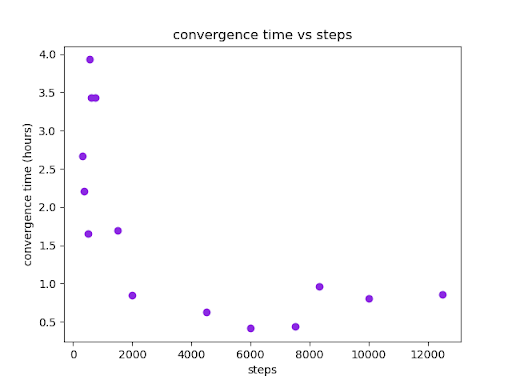
As a general rule, increasing the number of steps and decreasing the number of walkers increases the total computation time but ensures convergence. Decreasing the number of steps and increasing the number of walkers reduces the computation time but risks a failure to converge.